Sunday, December 14, 2025

Holiday Jazz 2025: A Vince Guaraldi celebration!

 [Web master's note: Northern California film critic Derrick Bang —  the eldest, youngest and only son of this site's primary jazz guru, the late Ric Bang — has surveyed the holiday jazz scene for more than a quarter century (!). Check out previous columns by clicking on the CHRISTMAS label below.]


2025 marks the 75th anniversary of Charles M. Schulz’s Peanuts, which debuted in a mere seven newspapers on October 2, 1950. It’s also the 60th anniversary of A Charlie Brown Christmas, which debuted December 9, 1965. Likely as a result, several of the regional combos that have made a cottage industry of holiday-themed shows dominated by Guaraldi’s music from A Charlie Brown Christmas have released albums this season. They’re covered below, along with the usual assortment of tasty entries from all manner of folks.


Onward!


********


Fans of straight-ahead trios will adore German jazz pianist Martin Sasse’s Swinging Christmas, which immediately went to my Constant Rotation playlist. He’s joined here by bassist Martin Gjakonovsky — one of Europe’s most prominent jazz artists — and Dutch drummer Joost van Schaik. To say these three guys are tight is an understatement; they obviously occupy each other’s minds.

The interplay between Sasse and Gjakonovsky is terrific throughout, whether the bass comps behind improv piano bridges, or vice versa.


The album opens with a feisty, mid-tempo reading of “Santa Claus Is Coming to Town,” highlighted by the first of Sasse’s many inventive improv solos: both cascades of single-note melodies, and — when the bridge shifts into swing time — equally sparkling chord progressions. “White Christmas” is as an equally up-tempo finger-snapper, boasting a lightning-swift piano bridge against Gjakonovsky’s sleek walking bass … along with a nod to Count Basie, during the three-note finale.


The trio is equally adept at gentler numbers, such as a sweetly solemn reading of “Angels We Have Heard on High,” the hymn-like arrangement of “Lo, a Rose E’er Blooming” and a bittersweet handling of “Have Yourself a Merry Little Christmas.” Sasses’ improv bridge of the latter wanders all over the keyboard, with deconstructed bits of melody reflecting the emotion of the melancholy moment in 1944’s Meet Me in St. Louis, when Judy Garland sings the tune to young Margaret O’Brien. The sacred German carol “Heiligste Nacht (Most Holy Night)” also gets a hymn-like approach and lyrical keyboard bridge.


The pace picks up again in a dynamic handling of the German Christmas carol “Zu Bethlehem Geboren (Born in Bethlehem),” boasting lively keyboard runs with lightning-fast filigrees and a tasty (albeit too brief) drum solo. The album concludes with a kick-ass arrangement of “Sleigh Ride,” with the melody taken on pennywhistle (!) against Gjakonovsky’s fiery walking bass; you can practically hear the snow-driven sleigh runners. Sasse inserts a vibrant keyboard bridge, and then everybody brings the tune home: a great finish to a truly enjoyable album.


Thursday, December 5, 2024

Holiday Jazz 2024: An international affair

[Web master's note: Northern California film critic Derrick Bang —  the eldest, youngest and only son of this site's primary jazz guru, Ric Bang — has surveyed the holiday jazz scene for more than a quarter century (!). Check out previous columns by clicking on the CHRISTMAS label below.]


Holiday albums appear earlier every year, so I was able to begin this annual survey in October ... and, for the next several weeks, it looked like 2024 would be a dismal year for new holiday jazz releases.


Happily, things improved as we slid into mid-November — thanks also to a few slightly older international albums that came to my attention — and you’ll find plenty to enjoy here (along with a few ... not so much).


Onward!


********


The New York-based Interplay Jazz Orchestra, formed in 2003, has maintained a monthly residency at Stony Brook’s The Jazz Loft since 2016. The 16-member unit’s holiday-themed shows have become go-to events every December, with upcoming dates at The Jazz Loft (December 14) and Bay Shore’s Boulton Center for the Performing Arts (December 20-21).

It’s Christmas Again, the most recent of their three albums, was released just a little over a year ago. The arrangements are inventive, and solos are just as dynamic as the unison horn work. A strong sense of fun radiates from this album, which is immediately evident in a rollicking, up-tempo handling of “All I Want for Christmas Is You,” powered by Cameron Escovedo’s drumming, and highlighted by John Marshall’s tenor sax solo.


“Santa Claus Is Coming to Town” is equally vibrant, with an intro by the full band segueing to lovely unison horns delivering the familiar melody. Jay Orig’s sassy piano solo is complemented by Dave Lobenstein’s walking bass; Baron Lewis then delivers a sparkling trumpet solo, after which the full unit returns for a thundering finale. “Rudolph, the Red-Nosed Reindeer” emerges as a delicious cha-cha, with solos on trombone (Joey Devassy), alto sax (Chris Donohue) and trumpet (Damien Pacheco), backed by Orig’s delicate piano filigrees. You’ll also hear a cheeky bit of horseracing’s “First Call.”


Sweet unison horns are backed by a percussive, toe-tapping vamp in “Little Drummer Boy,” with fanfares introducing tasty solos on alto sax (Jim Miceli) and tenor sax (Alejandro Aviles). 


My favorite track, though, is the 5/4 arrangement (!) of “Christmas Time Is Here.” Escovedo and Lobenstein lay down a swinging beat behind the unison horns that carry the theme, with improv shading supplied by Donohoe’s alto sax and Marshall’s tenor sax. (I played this track three times, before listening to the rest of the album.)


The party concludes with a leisurely, wistful reading of “Auld Lang Syne,” with unison horns backed by Escovedo’s strong beat; the arrangement has a definite “end of the evening vibe,” augmented by brief solos on tenor sax (Marshall) and trombone (Joey Devassy).


My sole lament is that the album favors horn solos; I wish Orig had cut loose on piano a few more times. Hold that thought for the next time!

Sunday, December 17, 2023

Holiday jazz 2023: Back to basics

[Web master's note: Northern California film critic Derrick Bang —  the eldest, youngest and only son of this site's primary jazz guru, Ric Bang — has surveyed the holiday jazz scene for more than a quarter century (!). Check out previous columns by clicking on the CHRISTMAS label below.]


In early November, this looked like another disappointing year for holiday jazz.


With fewer than half a dozen albums to consider — some still not released, as of that moment — I anticipated a woefully brief column.


Happily, an expanding number of late arrivals — some from quite obscure sources — has turned this annual survey into a joyful occasion akin to the pre-Covid years.


(A passing word, about those aforementioned “obscure sources.” A growing number of musicians are choosing either to distribute solely from their own web sites, or via micro-operations that seem to handle very little else. While I can appreciate an artist’s desire to eliminate the percentage paid to Amazon and its ilk, this decision makes it extremely difficult to find such releases. So ... is it really a better retail scheme?)


As also is a growing trend, several of the following albums are available solely as digital downloads: no physical media.


Back when I began this annual survey, it was fairly common for holiday jazz albums to include covers of Vince Guaraldi’s “Christmas Time Is Here,” and sometimes “Linus and Lucy” and “Skating.” More recently, I’m seeing an increased numbers of full albums devoted to Guaraldi’s Peanuts tunes — with emphasis on music from the Christmas TV special — and the following list includes two.


Onward!


********


This band, quite simply, is a force of nature.

Big Band Holidays III follows earlier 2015 and ’19 releases by Wynton Marsalis and the 14-piece Jazz at Lincoln Center Orchestra: absolutely the finest, tightest, swingingest unit performing today. (If this quadrennial trend continues, we can expect another release in 2027, and it can’t come quickly enough.)


This new album roars out of the gate with an explosive, double-time reading of “Go Tell It on the Mountain” that boasts sensational unison horn work, screaming sax and horn solos, and a vigorous pace that’ll leave listeners breathless. Marsalis brings down the intensity for a lovely “Christmas Time Is Here,” with the melody taken by sweet muted trumpets and Carlos Henriquez’s bass comping; Victor Goines supplies a tasty clarinet solo, after which the full band brings this venerable tune to a gorgeous conclusion, accompanied by lovely horn filigrees.


Those are the only two instrumentals. Vocalist Denzal Sinclaire trades lyrics with band passages during a buoyant reading of “Caroling, Caroling”; the clever arrangement finds Sinclaire singing in “slow time,” while the band backs him at twice the speed. Sleek solos are inserted by Ted Nash (alto sax) and Dan Nimmer (piano), then Sinclaire returns and noodles a bit of “Silver Bells” to bring the tune to a quiet finale.


Sinclaire has more fun with a playful run at “All I Want for Christmas Is My Two Front Teeth,” particularly when he pauses a few times, and “tries to whistle.” Henriquez and Marcus Printup (trumpet) supply deft solos, then Sinclaire concludes the tune while backed by a unison male choir.


The full choir delivers a vocalese introduction to “What Child Is This,” after which the rhythm section begins a vamp that introduces vocalist Vuyo Sotashe, who trades verses with the full band; tasty solos comes from Printup and Christopher Crenshaw (trombone). The band goes R&B for a pensive arrangement of Donny Hathaway’s “This Christmas,” with Kim Burrell softly crooning the initial lyrics, until she turns into a dynamic belter who gives soloists Vincent Gardner (trombone) and Sherman Irby (alto sax) plenty of competition.


The album’s dramatic finale, “No Room at the Inn,” is a full-blown gospel number with the audience clapping in time as Catherine Russell introduces Mahalia Jackson’s (rather redundant) lyrics, fueled by Nimmer’s lively keyboard work. Russell whips the audience into a frenzy as the full band gets louder; energetic solos come from Printup, Gardner and Walter Blanding (tenor sax). It all feels like part of the most glorious church service ever, and the audience erupts in cheers when the tune concludes.


At which point, all I can say is Whew.


Friday, December 9, 2022

Holiday Jazz 2022: Where did everybody go?

[Web master's note: Northern California film critic Derrick Bang —  the eldest, youngest and only son of this site's primary jazz guru, Ric Bang — has surveyed the holiday jazz scene for a quarter century (!), with lengthy columns that just keep growing. Check out previous columns by clicking on the CHRISTMAS label below.]


Pickings were slim last year, for an abundance of reasons: Covid concerns, supply-chain issues, the lack of performance venues with patrons willing to attend in sufficient numbers, and the closure of studios unable to sufficiently staff the recording and engineering.


Alas, my annual round-up is even more sparse this year, and I can’t imagine why. Has the world abandoned holiday jazz?


I’ve focused primarily on instrumental ensembles, during the past couple of decades — purely a personal preference, no indictment of vocalists intended — but “needs must” forces a slightly broader sweep this time.


Onward, then…


********


Learning that chanteuse Lyn Stanley was “discovered” by the late, great jazz pianist Paul Smith — whom I’ve admired since first hearing him back in my teen years — immediately moved her debut holiday release to the top of the stack. (Check out her terrific handling of “Makin’ Whoopee,” backed by Smith’s trio in February 2011, at Alva’s Showroom in San Pedro, California.)

Novel Noël is an excellent showcase for Stanley, particularly when backed by the full-blown fury of Tom Kubis’ big band. (My reviews of his 2002 and 2015 holiday jazz albums can be found here and here.)


Her album opens with a whimsical, mildly ookie-spooky arrangement of “ ’Zat You, Santa Claus,” made famous by Louis Armstrong, whose distinctive voice Stanley cleverly imitates during the initial bars. Kubis’ band lends swinging support, with cool solos on sax and guitar, and a cute walking bass finale. An atypically jaunty handling of “Have Yourself a Merry Little Christmas” is even better, with Stanley generously yielding to a terrific keyboard solo; she returns as the tune builds to a socko finale.


“The Little Drummer Boy” gets a clever 5/4 arrangement with familiar “Take Five” percussion elements; the keyboard comping is particularly nice behind Stanley’s vocal. A peppy blast of big band fury opens “The Christmas Waltz,” with Stanley’s vocal chops yielding to tasty guitar and piano solos, before the tune builds to another vibrant finish.


Not all of this album’s tracks are holiday-specific. Stanley’s saucy vocal highlights a tango-flavored reading of Sammy Cahn’s “Come Dance with Me,” which builds to a come-hither, cha-cha-cha climax. The Jerome Kern/Dorothy Fields standard, “The Way You Look Tonight,” begins playfully, before charging into swing time with a wild big band bridge; soft solo piano backs Stanley when she brings the tune to a close.


The instrumentation for a sweet arrangement of John Blackburn/Karl Suessdorf’s “Moonlight in Vermont” is more orchestral than jazz; Stanley’s approach is soft and sexy, and the track is punctuated by a fine trumpet solo.


A clever handling of “Merry Christmas Darling” begins in a similarly gentle vein, until Kubis’ band explodes in double-time fury while Stanley’s vocal maintains a conventional tempo; the juxtaposition is quite distinctive.


The album concludes with two quiet orchestral “bonus tracks” that must’ve been recorded at a different time, with a different configuration: mostly piano and soft strings. A clever arrangement of “Holy Night” includes quotes from “Carol of the Bells,” while Stanley’s breathy handling of “Mary Did You Know” is achingly poignant.


This album is a true seasonal highlight.

Wednesday, December 8, 2021

Holiday Jazz 2021: The lockdown edition

[Web master's note: Northern California film critic Derrick Bang —  the eldest, youngest and only son of this site's primary jazz guru, Ric Bang — has surveyed the holiday jazz scene for a quarter century (!), with lengthy columns that just keep growing. Check out previous columns by clicking on the CHRISTMAS label below.]


The pickings are slim this year, no doubt prompted by Covid fears, the lack of open performance venues with patrons willing to attend in sufficient numbers, the closure of studios unable to sufficiently staff the recording and engineering, and probably even supply-chain issues that have stalled all manner of retail goods … including, yes, recorded music.


Small combos still could have recorded material in isolation, of course, and then issued the results via social media. But it’s tough (impossible?) for most artists to generate a revenue stream that way, and musicians are like everybody else: They need to eat.


I hope the brevity of the following list is merely a temporary aberration. I’d hate to think holiday jazz was falling out of favor!


Onward, then…


********


A few releases always arrive late each year, sometimes into January, and therefore get saved until the following season. Let’s start with a few of those, and they’re corkers.


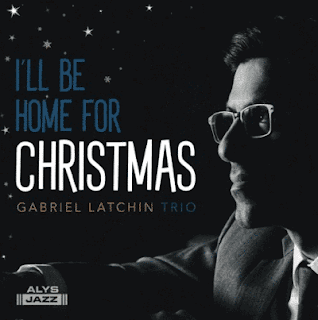
British pianist Gabriel Latchin has become quite a fixture across the pond, appearing regularly at premier London jazz venues such as Ronnie Scott’s, Pizza Express Jazz Club and the 606. He gets excellent support on I’ll Be Home for Christmas — his third album — from Dario Di Lecce (double bass) and Josh Morrison (drums). 

Latchin’s touch is both dynamic and tasty; his lengthy improvisational bridges are melodic, lyrical and fun. I suspect he spends a lot of time smiling, during live performances; his keyboard work positively sparkles. The set list is dominated by 1930s and ’40s titles from Great American Songbook composers, but Latchin’s arrangements have a clever twist: They’re interpreted through the eyes (and fingers) of his musical idols.


Thus, Latchin’s gentle, leisurely approach to “I’ll Be Home for Christmas,” with its thoughtful bridge, is straight out of Bill Evans: all the way up to its effervescent finish. Latchin’s reverential introduction to “God Rest Ye Merry, Gentlemen” slides into traditional swing, and then explodes with a lengthy, forcefully sassy piano solo that reminds me of Herbie Hancock.


Latchin channels Ahhad Jamal for a peppy run at “Rudolph, the Red-Nosed Reindeer,” backed by Morrison’s rapid-fire, double-time percussion. The latter also takes a vibrant drum solo, which totally cooks. Other idols cited in the album’s liner notes include Thelonious Monk, Cedar Walton, Phineas Newborn and Barry Harris. 


I detect Monk in “Winter Wonderland,” with its mildly mysterious atmosphere. The arrangement also cleverly messes with time signatures, and Di Lecce’s walking bass is particularly choice. As for Walton and the others … I’m not sure.


Di Lecce opens the melody on “Jingle Bells,” and also has a cool solo following another of Latchin’s fiery bridges. He begins “The Christmas Song” with a slow, delicate keyboard intro, and then Morrison kicks things into double-time, and the tune takes on a bossa nova ambiance. “White Christmas” is simply gorgeous, with another soft keyboard intro, after which Latchin gives the tune a contemplative atmosphere, backed by Di Lecce’s lovely walking bass.


“A Toast to Friends,” a Latchin original, is a charming ballad that genuine sounds like its title; Di Lecce is granted another of his sleek solos. The album concludes with a mid-tempo, rolling waltz reading of “Silent Night”: a bit peppier than this perennial carol usually warrants, with Morrison’s drums setting a cheerful mood.


As you’ve likely realized by now, yes: This one’s a keeper. It’s lush.

Monday, November 30, 2020

Holiday Jazz 2020: A world affair!

[Web master’s note: Northern California film critic Derrick Bang — the eldest, youngest and only son of this site’s primary jazz guru, Ric Bang — has surveyed the holiday jazz scene for 24 years, with lengthy columns that just keep growing. Check out previous columns by clicking on the CHRISTMAS label below.]


As a greater number of releases have become solely digital, it has gotten harder to separate the (rare) wheat from the (all too common) chaff. The primary reason is an absence of data. Most digital releases offer only a cover image, and nothing else, in the way of information. No little essay about or by the primary artist(s), no recording or mastering engineers, and — quite often — no instrument personnel. 


This is a frustrating a throwback to the early days of LPs, when (as but one example) several of Vince Guaraldi’s Fantasy albums failed to credit his sidemen. It was rude and unacceptable then, and it’s just as intolerable now.


I also mourn the loss of cdbaby’s online store, which ceased operation in March, in order to focus exclusively on helping artists to monetize and promote their music. Every album listed in the former store — whether digital or hard media — had its own page, with all the essential information one would expect from a detailed CD booklet. Visitors also could sample tracks from every entry.


Fortunately, iTunes, Spotify and Amazon still allow sampling.


Even so…


Little by little, it’s getting harder to “browse” music — as in the good ol’ days of record bins — looking for wonderful stuff that you won’t know you want, until you stumble across it.


This is progress?


I think not.


********


New York-based pianist Ben Paterson is both a Steinway artist and winner of 2018’s inaugural Ellis Marsalis International Jazz Piano Competition. No surprise, then: He has serious keyboard chops. He also performs smoothly alongside bassist Luke Sellick and drummer Charles Goold, with whom he shares one of those symbiotic relationships that suggests mutual mind-reading. They’re a tight unit, and I’ll Be Thanking Santa is a terrific album.


Paterson is a generous leader, granting Sellick almost as much solo time as he takes himself. Sellick favors walking bass, and his licks are quite engaging on “O Tannenbaum” and “Winter Wonderland.” He also introduces the melody on “The Christmas Waltz” and subsequently dominates that tune.


Goold tends to be less visible, establishing solid rhythmic backing without calling attention to himself; it’s almost startling when he takes occasional drum solos, on “God Rest Ye Merry, Gentlemen” and “Winter Wonderland.”


I love Paterson’s solo introduction on a thoughtful reading of “The Christmas Song”; his keyboard work sounds like a series of melodic questions and answers. His contemplative solo handling of “Have Yourself a Merry Little Christmas” precisely captures the wistful tone Judy Garland gave that song, when she introduced it in 1944’s Meet Me in St. Louis.


“O Tannenbaum” is a groovy, mid-tempo toe-tapper that challenges listeners not to get up and boogie; the arrangement of “Christmas Time Is Here” is much peppier than usual, backed by driving rhythm that feels like a moving train. “I’ll Be Home for Christmas” emerges as a bossa nova sparkler, while the Tagalog carol “Pasko Na Naman” is transformed into a tango-esque swinger that builds to an aggressive climax by all three musicians. Paterson also is all over the keyboard during most of “Winter Wonderland”; it’s easy to see how he won that Marsalis competition.


Paterson includes two vocal originals. “Christmas, Won’t You  Stick Around for Awhile” is a wistful ode to those who can’t bear to see the holiday season conclude; “I’ll Be Thanking Santa” is a cheerier love song that acknowledges life’s truly most important gifts. Both tunes boast clever lyrics and rhymes; Paterson definitely could moonlight as a songwriter.


This album demands heavy rotation on your playlist.


Wednesday, December 4, 2019

Holiday Jazz 2019: Plenty of tasty stocking-stuffers

[Web master’s note: Northern California film critic Derrick Bang — still the eldest, youngest and only son of this site’s primary jazz guru, Ric Bang — has surveyed the holiday jazz scene for 23 years, with lengthy columns that just keep growing. Check out previous columns by clicking on the CHRISTMAS label below.]


Let’s start with a blast from the past, finally (finally!) making its debut on CD.

Longtime holiday jazz fans have always prized the Ramsey Lewis Trio’s two classic albums: 1961’s Sound of Christmas and 1964’s More Sounds of Christmas. Both initially were released by Argo and then reissued by Cadet and Chess; the first one went digital in 1989, first on Chess/MCA, and then on Verve. The second album logically should have hit CD simultaneously … but that didn’t happen.

Three decades passed (!). Then, just a few months ago, Verve quietly issued More Sounds of Christmas on CD. Modern listeners now can delight in the trio’s droll handling of “Snowbound,” “We Three Kings” and “Jingle Bells” — the latter a particularly saucy arrangement — and numerous other seasonal chestnuts, along with a couple of originals (“Egg Nog” and “Plum Puddin’ ”). 

The hitch: Five of the 10 tracks are accompanied by syrupy strings, which’ll raise an eyebrow or two. (Oh, well.)

Folks just starting a holiday jazz collection will be delighted by New Continent’s Christmas Hits: Jazz, Lounge and Rhythm & Blues. This three-disc anthology offers 25 iconic tracks in each of the three genres. The Christmas Jazz CD features classics by Duke Ellington, Ella Fitzgerald, Stan Kenton, Mel Tormé, Chet Baker and many others. Christmas Lounge is laden with vocals by Bing Crosby, Dean Martin, Johnny Mathis, Judy Garland, Eartha Kitt, Julie London and others. Christmas Rhythm & Blues, finally, is a smorgasbord featuring The Cadillacs, Brenda Lee, Elvis, Chuck Berry, The Drifters and much more.

With 75 tracks for slightly less than $13, you can’t go wrong!

As this survey was going to bed, Santa dropped a copy of up-and-coming vocalist Rebecca Angel’s CD single cover of “Santa Baby.”Considerable bravery is required to tackle this classic, in the wake of Eartha Kitt’s iconic 1953 version, along with respectable later covers by Kylie Minogue and Madonna. To her credit, Angel has the appropriate little-girl coo, and her flirty reading is backed by a tasty quintet: Dennis Angel (Flugelhorn), Jason Miles (keyboards), Jonah Prendergast (guitar), Reggie Washington (bass) and Brian Dunne (drums).

But will it stand the test of time? Hard to say. 

Now, let’s see what else Santa brought jazz fans this year (or recently, anyway) …

***************