Showing posts with label Mich Shirey. Show all posts

Sunday, December 14, 2025

Holiday Jazz 2025: A Vince Guaraldi celebration!

 [Web master's note: Northern California film critic Derrick Bang —  the eldest, youngest and only son of this site's primary jazz guru, the late Ric Bang — has surveyed the holiday jazz scene for more than a quarter century (!). Check out previous columns by clicking on the CHRISTMAS label below.]


2025 marks the 75th anniversary of Charles M. Schulz’s Peanuts, which debuted in a mere seven newspapers on October 2, 1950. It’s also the 60th anniversary of A Charlie Brown Christmas, which debuted December 9, 1965. Likely as a result, several of the regional combos that have made a cottage industry of holiday-themed shows dominated by Guaraldi’s music from A Charlie Brown Christmas have released albums this season. They’re covered below, along with the usual assortment of tasty entries from all manner of folks.


Onward!


********


Fans of straight-ahead trios will adore German jazz pianist Martin Sasse’s Swinging Christmas, which immediately went to my Constant Rotation playlist. He’s joined here by bassist Martin Gjakonovsky — one of Europe’s most prominent jazz artists — and Dutch drummer Joost van Schaik. To say these three guys are tight is an understatement; they obviously occupy each other’s minds.

The interplay between Sasse and Gjakonovsky is terrific throughout, whether the bass comps behind improv piano bridges, or vice versa.


The album opens with a feisty, mid-tempo reading of “Santa Claus Is Coming to Town,” highlighted by the first of Sasse’s many inventive improv solos: both cascades of single-note melodies, and — when the bridge shifts into swing time — equally sparkling chord progressions. “White Christmas” is as an equally up-tempo finger-snapper, boasting a lightning-swift piano bridge against Gjakonovsky’s sleek walking bass … along with a nod to Count Basie, during the three-note finale.


The trio is equally adept at gentler numbers, such as a sweetly solemn reading of “Angels We Have Heard on High,” the hymn-like arrangement of “Lo, a Rose E’er Blooming” and a bittersweet handling of “Have Yourself a Merry Little Christmas.” Sasses’ improv bridge of the latter wanders all over the keyboard, with deconstructed bits of melody reflecting the emotion of the melancholy moment in 1944’s Meet Me in St. Louis, when Judy Garland sings the tune to young Margaret O’Brien. The sacred German carol “Heiligste Nacht (Most Holy Night)” also gets a hymn-like approach and lyrical keyboard bridge.


The pace picks up again in a dynamic handling of the German Christmas carol “Zu Bethlehem Geboren (Born in Bethlehem),” boasting lively keyboard runs with lightning-fast filigrees and a tasty (albeit too brief) drum solo. The album concludes with a kick-ass arrangement of “Sleigh Ride,” with the melody taken on pennywhistle (!) against Gjakonovsky’s fiery walking bass; you can practically hear the snow-driven sleigh runners. Sasse inserts a vibrant keyboard bridge, and then everybody brings the tune home: a great finish to a truly enjoyable album.

 

Wednesday, December 8, 2021

Holiday Jazz 2021: The lockdown edition

[Web master's note: Northern California film critic Derrick Bang —  the eldest, youngest and only son of this site's primary jazz guru, Ric Bang — has surveyed the holiday jazz scene for a quarter century (!), with lengthy columns that just keep growing. Check out previous columns by clicking on the CHRISTMAS label below.]


The pickings are slim this year, no doubt prompted by Covid fears, the lack of open performance venues with patrons willing to attend in sufficient numbers, the closure of studios unable to sufficiently staff the recording and engineering, and probably even supply-chain issues that have stalled all manner of retail goods … including, yes, recorded music.


Small combos still could have recorded material in isolation, of course, and then issued the results via social media. But it’s tough (impossible?) for most artists to generate a revenue stream that way, and musicians are like everybody else: They need to eat.


I hope the brevity of the following list is merely a temporary aberration. I’d hate to think holiday jazz was falling out of favor!


Onward, then…


********


A few releases always arrive late each year, sometimes into January, and therefore get saved until the following season. Let’s start with a few of those, and they’re corkers.


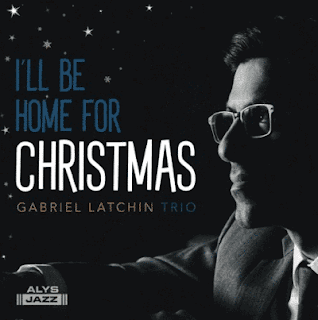
British pianist Gabriel Latchin has become quite a fixture across the pond, appearing regularly at premier London jazz venues such as Ronnie Scott’s, Pizza Express Jazz Club and the 606. He gets excellent support on I’ll Be Home for Christmas — his third album — from Dario Di Lecce (double bass) and Josh Morrison (drums). 

Latchin’s touch is both dynamic and tasty; his lengthy improvisational bridges are melodic, lyrical and fun. I suspect he spends a lot of time smiling, during live performances; his keyboard work positively sparkles. The set list is dominated by 1930s and ’40s titles from Great American Songbook composers, but Latchin’s arrangements have a clever twist: They’re interpreted through the eyes (and fingers) of his musical idols.


Thus, Latchin’s gentle, leisurely approach to “I’ll Be Home for Christmas,” with its thoughtful bridge, is straight out of Bill Evans: all the way up to its effervescent finish. Latchin’s reverential introduction to “God Rest Ye Merry, Gentlemen” slides into traditional swing, and then explodes with a lengthy, forcefully sassy piano solo that reminds me of Herbie Hancock.


Latchin channels Ahhad Jamal for a peppy run at “Rudolph, the Red-Nosed Reindeer,” backed by Morrison’s rapid-fire, double-time percussion. The latter also takes a vibrant drum solo, which totally cooks. Other idols cited in the album’s liner notes include Thelonious Monk, Cedar Walton, Phineas Newborn and Barry Harris. 


I detect Monk in “Winter Wonderland,” with its mildly mysterious atmosphere. The arrangement also cleverly messes with time signatures, and Di Lecce’s walking bass is particularly choice. As for Walton and the others … I’m not sure.


Di Lecce opens the melody on “Jingle Bells,” and also has a cool solo following another of Latchin’s fiery bridges. He begins “The Christmas Song” with a slow, delicate keyboard intro, and then Morrison kicks things into double-time, and the tune takes on a bossa nova ambiance. “White Christmas” is simply gorgeous, with another soft keyboard intro, after which Latchin gives the tune a contemplative atmosphere, backed by Di Lecce’s lovely walking bass.


“A Toast to Friends,” a Latchin original, is a charming ballad that genuine sounds like its title; Di Lecce is granted another of his sleek solos. The album concludes with a mid-tempo, rolling waltz reading of “Silent Night”: a bit peppier than this perennial carol usually warrants, with Morrison’s drums setting a cheerful mood.


As you’ve likely realized by now, yes: This one’s a keeper. It’s lush.